
Ford EcoSport Common Faults in the UK
one generation 2014–2023 (facelifted 2018) — small SUV. Updated 27 November 2026.
This guide covers the one generation 2014–2023 (facelifted 2018). For any other version of the EcoSport, see how to check any car for known faults.
What Car? says early Ford EcoSports suffered from the “wet belt” cambelt, which runs in engine oil and can disintegrate before Ford’s estimated life, and that Ford fitted a chain from 2019 (page updated 8 May 2025). DVSA lists recalls for rear suspension bolts (R/2015/126) and fuel tubes (R/2016/102), so check each car by registration. EcoSports registered 2014–2022 pass the MOT above all cars registered those years in 1 of 9 years, below in 6 and level in 2.
Largest DVSA recall for the EcoSport: R/2015/126, 1,264 vehicles — Vehicle may become unstable due to rear suspension fault.
82.9% of Ford EcoSports pass the MOT first time, 1.3 points worse than the national average for cars of the same age (84.2%). Counted from 11,471 DVSA tests on cars registered 2014–2022; a pass with rectification at the station counts as a pass here, and as a failure in DVSA's own initial-test measure.
Source: DVSA MOT Anonymised Data 2025 (Open Government Licence v3.0), a sample of the 2025 file (about one test in ten, from nine months). Class 4 tests in Great Britain, test type NT (a normal annual test), retests excluded. A pass, or a pass with rectification at the station, counts as a pass here (passed on the day); DVSA's own initial-test measure counts a rectified pass as a failure and so reports a lower figure. Testing in Northern Ireland is run separately by the DVA under its own rules. Compared against cars of the same registration years, because pass rates otherwise mostly measure how old a model's surviving fleet is.
See it by registration year and by mileage ↓What a Ford EcoSport costs on Autoza now
Median asking price of the Ford EcoSport on autoza.co.uk on 27 November 2026, by the year the car was first registered:
- Registered 2015–2017: £4,995
- Registered 2018–2020: £7,985
Asking prices on autoza.co.uk on 27 November 2026, not what buyers pay, worked out from the cars on sale when this page is generated. A year band is shown only when at least 10 cars qualify. Only cars first registered from 2014, the years this guide covers, are counted.
The asking-price figures above are the middle 80% and the median of what sellers were asking on Autoza on 27 November 2026 — not what buyers pay — for Ford EcoSport cars registered from 2014. They are worked out from the cars on sale when this page is generated, and none is shown when fewer than 10 cars qualify. The road tax line comes from GOV.UK's vehicle tax rate tables (2026/27 rates). The fuel economy tile names the source it rests on or says there is no sourced figure, and the insurance tile gives no figure. We do not publish a UK price index, and no figure here should be quoted as one.
Best and worst years to buy
We name a year as a best or worst buy only where the DVSA MOT table further down does not rate it the other way.
DVSA’s MOT table rates 2018 registrations 2.1 points above all cars registered that year, the only EcoSport year it rates above, and 2019 and 2021 level, so no single year stands out and none is called a best year. The 2018 car is within the years in which What Car? says the wet belt was fitted, so the belt history still matters. MOT results measure roadworthiness at the test, not engine or electronics reliability.
No year is named as one to avoid, but that is not clearance: DVSA’s MOT table rates 2014, 2015 and 2017 registrations 6.5, 5.1 and 4.8 points below all cars registered those years (from 283, 1,068 and 1,396 sampled tests), and 2016, 2020 and 2022 below too. The sources we read give no cause for the gap, so treat those years as ones to check harder, not as a named fault, and read the wet-belt, recall and survey notes below for what the sources do document.
Which Ford EcoSport years to avoid?
Ford EcoSport registrations from 2014, 2015, 2017 and 2020 did worse at MOT in 2025 than the average car registered in the same year. The widest gap was 2014: 32.2% failed, against 25.7% of all cars registered that year.
Separately, 3 of the 5 DVSA recalls listed for this model cover cars built between 2013 and 2014: that is the build-date stretch with the most recalls, so check any car from it by registration.
This is MOT test data: the MOT is a roadworthiness test, not a full reliability record, and it does not check the engine, clutch or gearbox. “Failed” means failed on the day, with cars fixed during the test counted as passes. A year is marked only where its gap is 3 points or more and beyond the 95% sampling margin for that many tests. See the full MOT results by year and mileage.
| Registered | EcoSport failed | All cars that year | Tests |
|---|---|---|---|
| 2022 | 11.0% | 8.8% | 983 |
| 2021 | 8.9% | 9.9% | 538 |
| 2020did worse than average | 15.2% | 11.3% | 853 |
| 2019 | 11.9% | 13.1% | 2,530 |
| 2018 | 13.4% | 15.5% | 2,224 |
| 2017did worse than average | 22.6% | 17.8% | 1,396 |
| 2016 | 23.3% | 20.6% | 1,568 |
| 2015did worse than average | 28.4% | 23.3% | 1,068 |
| 2014did worse than average | 32.2% | 25.7% | 283 |
Source: DVSA MOT Anonymised Data 2025 (Open Government Licence v3.0). Contains public sector information licensed under the Open Government Licence v3.0.
Known faults — Ford EcoSport one generation 2014–2023 (facelifted 2018)
How to read this list. Items marked Safety recall are DVSA safety recalls, shown with DVSA’s own reference. Whether a particular car is affected depends on when it was built: check it by registration through GOV.UK’s vehicle recall check. Everything else in this list is owner-reported: what the UK publication named on each card reports from its owner surveys and tests. Those are worth checking on a viewing, but we hold no count of how many cars have each one, other than any survey share a card itself quotes. Treat an owner-reported item as a question to ask, not a fault this car has.
Rear suspension trailing arm bolts (2013–2015 builds)
- Symptoms
- DVSA wording: the rear suspension trailing arm bolts may not have been tightened to the correct specification during assembly, and there is a possibility that a bolt could fail, making the vehicle unstable. The trailing arm nuts and bolts are replaced and tightened to the correct torque. What Car? and Auto Express both describe the recall (pages updated 8 May 2025 and published 29 December 2018).
- Years affected
- EcoSport built 29 November 2013 to 25 February 2015
- Indicative repair (UK)
- Free under recall
- What to check before buying
- Check this one by registration through GOV.UK’s vehicle recall check (gov.uk/check-vehicle-recall) before you buy — an outstanding recall is free to put right and a completed one should be on the service record. On a 2014 or 2015 car, listen for knocks from the rear underbody and ask for the dealer record.
Fuel tubes not earthed correctly — fuel leak (2013–2014 builds)
- Symptoms
- DVSA wording: the fuel tubes are not earthed correctly; an electrostatic discharge may cause a pin-size hole in a fuel tube and a subsequent fuel leak. A new conductive clip is installed on the fuel and brake tube bundle and attached to the body. A separate DVSA recall, R/2015/026, covers corrosion-prone fuel lines on 35 early cars.
- Years affected
- EcoSport built 19 April 2013 to 26 June 2014
- Indicative repair (UK)
- Free under recall
- What to check before buying
- Check this one by registration through GOV.UK’s vehicle recall check (gov.uk/check-vehicle-recall) before you buy — an outstanding recall is free to put right and a completed one should be on the service record. On a 2013–2014 car, look underneath for fuel dampness and ask for the dealer record.
DVSA’s counts, recall by recall: R/2016/102 1,023; R/2015/026 35.
Front lower control arm weld (2017 builds)
- Symptoms
- DVSA wording: the lower control arm weld may not meet specification, and the front lower control arms are inspected and new arms fitted if required.
- Years affected
- EcoSport built 2 May 2017 to 10 June 2017
- Indicative repair (UK)
- Free under recall
- What to check before buying
- Check this one by registration through GOV.UK’s vehicle recall check (gov.uk/check-vehicle-recall) before you buy — an outstanding recall is free to put right and a completed one should be on the service record. On a May or June 2017 car, ask whether the arms were inspected.
Software update for a cracked diesel particulate filter (2017–2018 builds)
- Symptoms
- DVSA wording: affected vehicles may develop a crack in the diesel particulate filter. The powertrain control module software is updated to prevent a cracked filter, and filters that are already cracked are tested and replaced.
- Years affected
- EcoSport diesels built 18 October 2017 to 5 May 2018
- Indicative repair (UK)
- Free under recall
- What to check before buying
- Check this one by registration through GOV.UK’s vehicle recall check (gov.uk/check-vehicle-recall) before you buy — an outstanding recall is free to put right and a completed one should be on the service record. On a late-2017 or early-2018 diesel, ask whether the software update was done.
Wet-belt cambelt on early cars
- Symptoms
- What Car? says early cars suffered from issues with the “wet belt” cambelt, a timing belt that runs inside the engine and is constantly lubricated by engine oil, which would disintegrate and weaken earlier than Ford’s estimated lifespan, resulting in engine damage if it breaks, and that Ford replaced the belt with a chain at the factory in 2019. Its page is updated 8 May 2025. Auto Express says the job is dearer on EcoBoost cars because the motor has to be lifted out (its page is published 29 December 2018). We print no interval or price because manufacturer intervals can be revised: ask a Ford dealer for the current one for the car’s engine.
- Years affected
- Early cars to 2018; chain from 2019 according to What Car?
- What to check before buying
- Ask for the full service history and any record of the cambelt being changed, and on a belt-driven 1.0 EcoBoost ask the dealer how it is looked after.
PowerShift automatic clutch wear
- Symptoms
- Auto Express says the PowerShift automatic transmission fitted to 1.5 petrol models can sometimes suffer from clutch wear, while the automatic fitted to EcoBoost-engined variants is a lot more durable. Its page is published 29 December 2018.
- Years affected
- 1.5 petrol PowerShift cars from summer 2015
- What to check before buying
- On an automatic, test pulling away gently and in traffic, and ask for the service record of the gearbox.
Electrical warning lights and diesel particulate filter
- Symptoms
- What Car? says that in its survey several EcoSport owners reported electrical gremlins, particularly warning lights appearing without a clear cause, and a few diesel drivers reported recurring diesel particulate filter issues that sometimes led to costly repairs outside warranty. Its page is updated 8 May 2025.
- Years affected
- One generation 2014–2023
- What to check before buying
- Check no warning light stays on after start-up, and on a diesel ask how the car has been driven and whether the filter has been looked at.
Tailgate-mounted spare wheel and side-hinged boot door
- Symptoms
- Auto Express says a tailgate-mounted full-size spare wheel was standard until October 2015, after which it became an option, and a car without it carries a tyre-mobility kit instead (its page is published 29 December 2018).
- Years affected
- Cars from October 2015 may have no spare wheel
- What to check before buying
- Check whether the car has a spare wheel or a repair kit, and that the tailgate opens and closes properly.
Cars like this for sale now
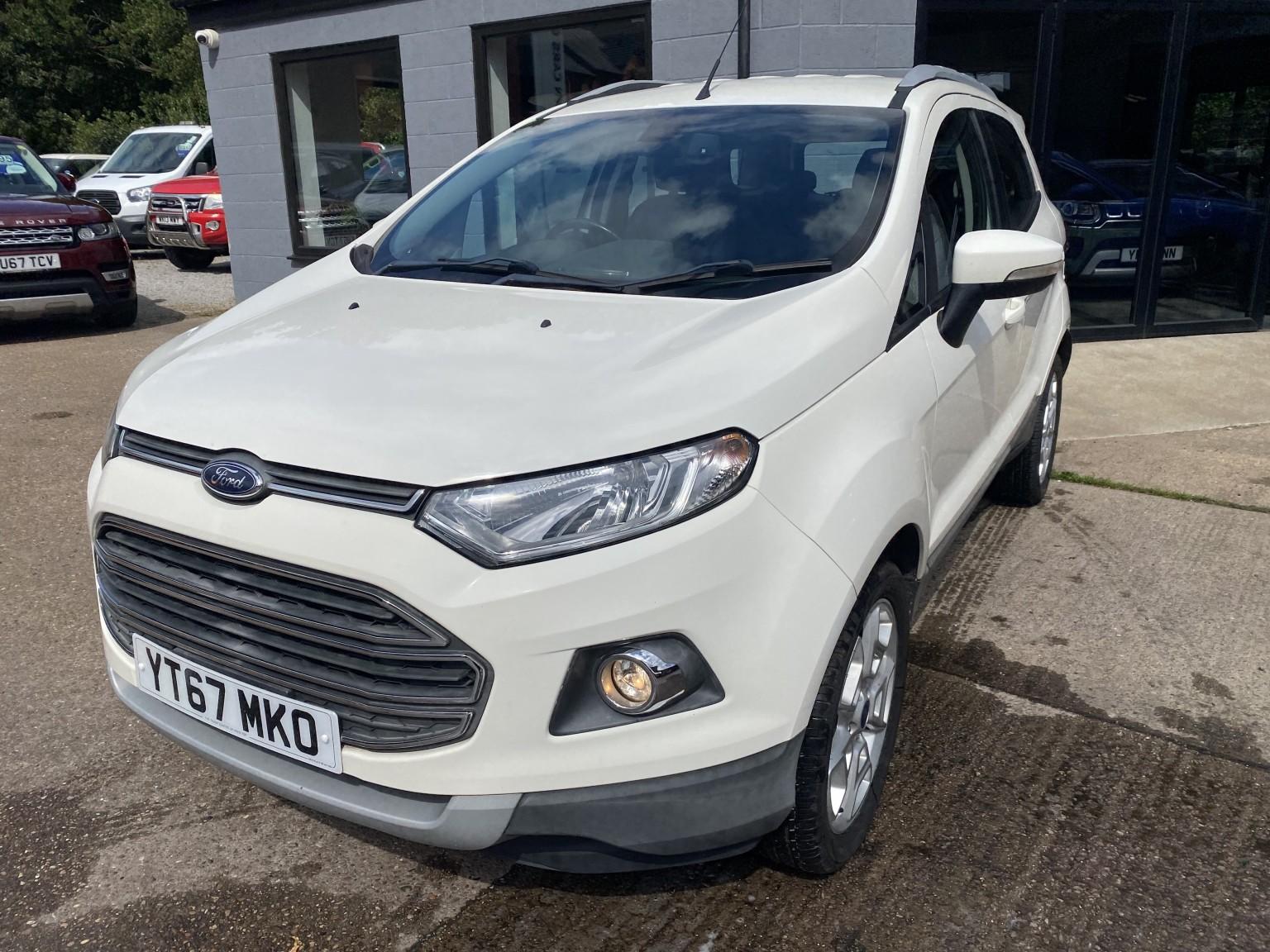
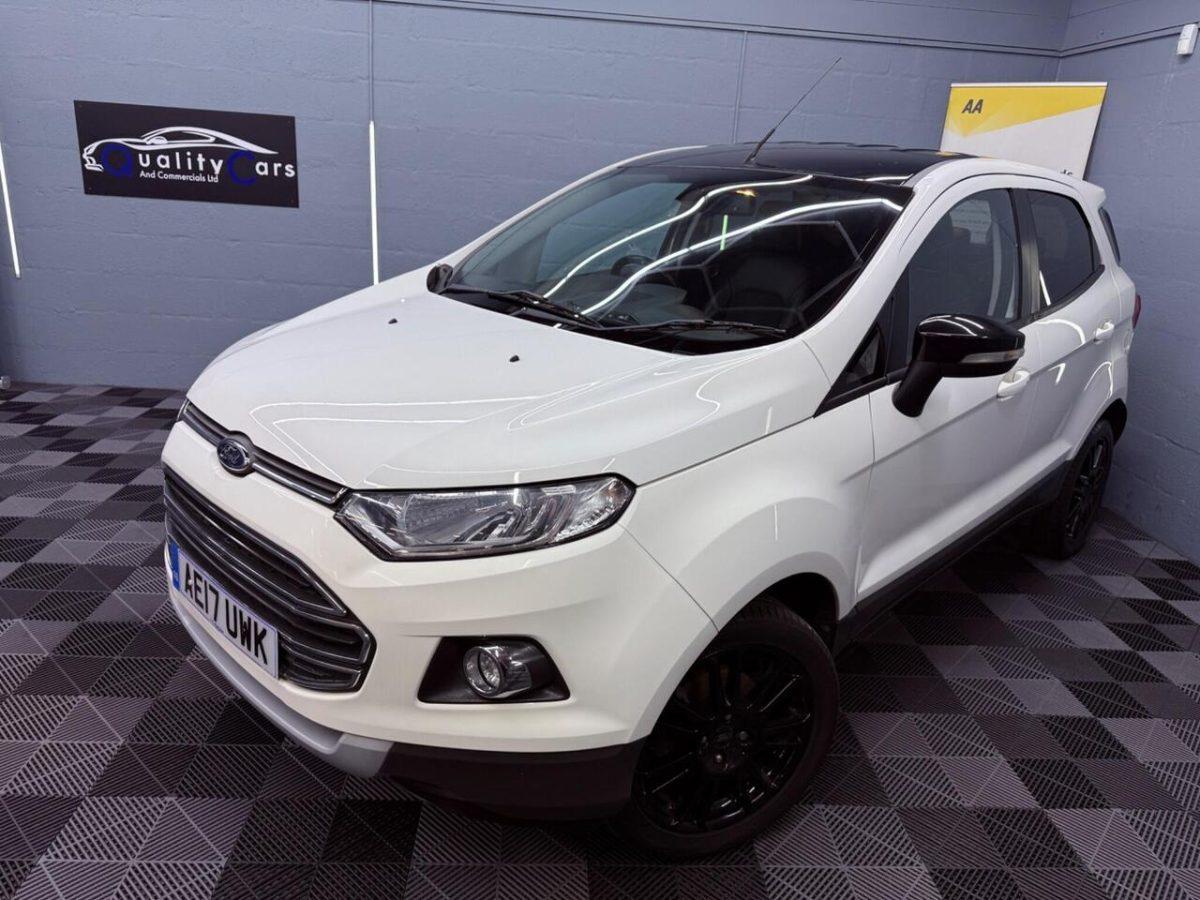
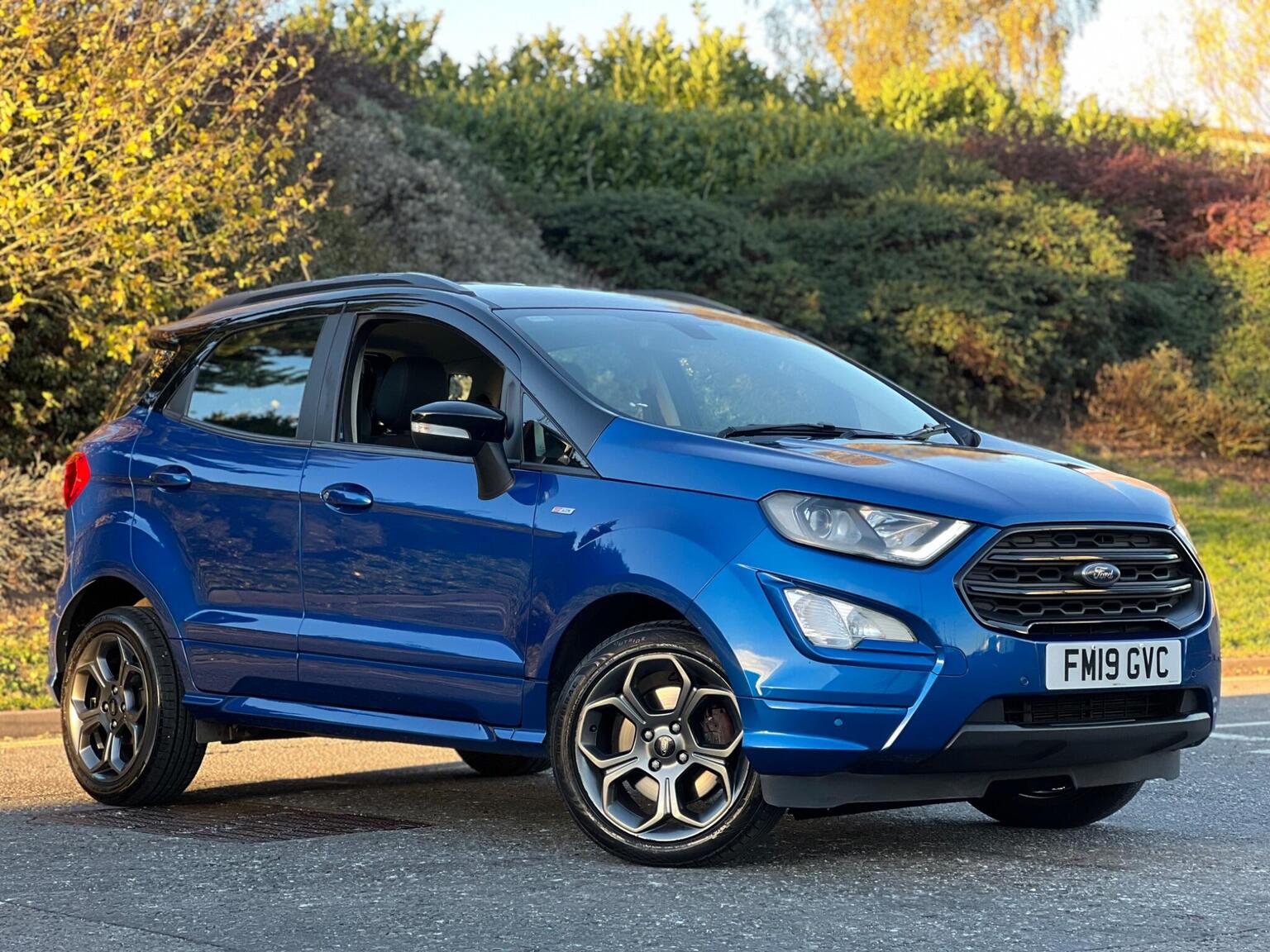
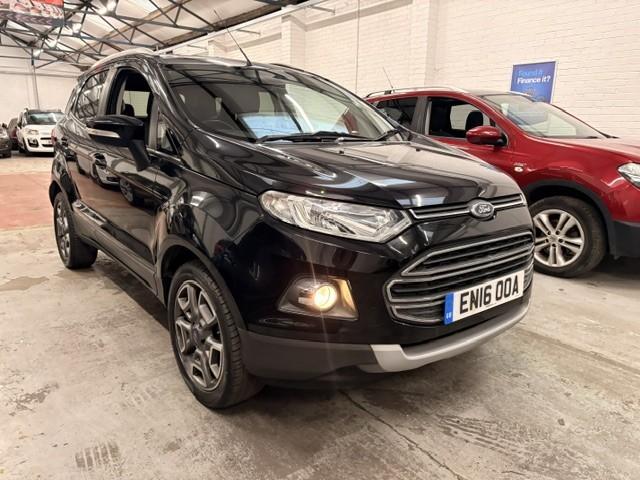
Used Ford EcoSport adverts on Autoza, each from a dealer you can contact from the advert.

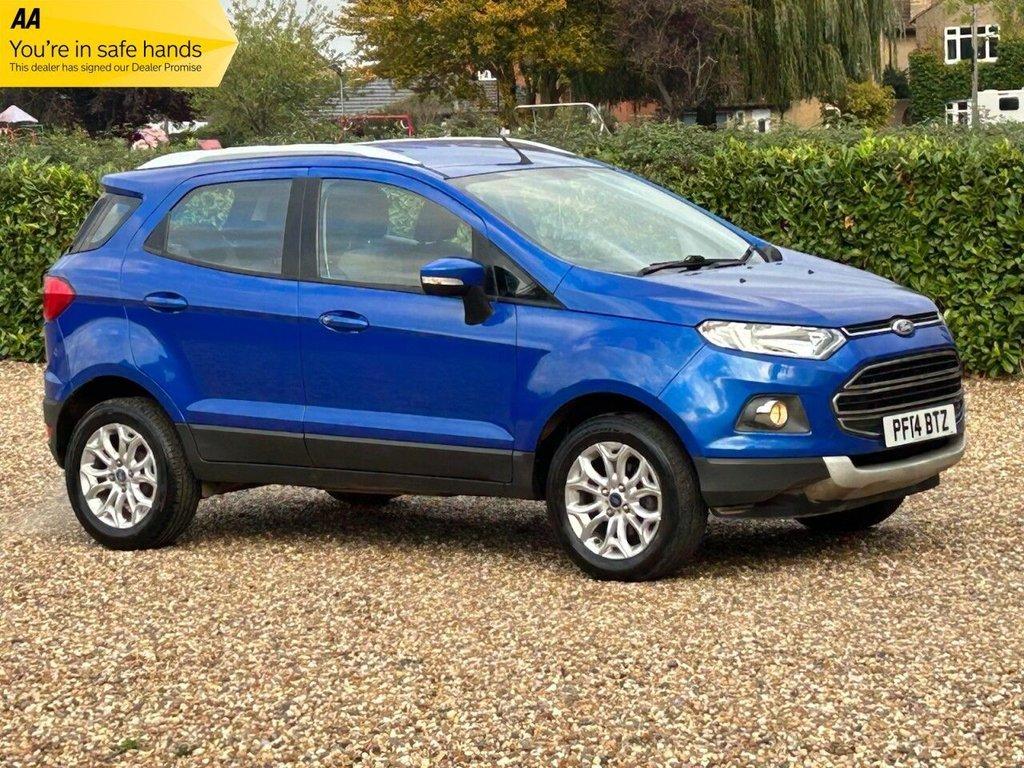
Ford EcoSport MOT results by year and mileage
Measured from DVSA’s own MOT test records for tests carried out in 2025, not from owner reports.
By registration year
Against all cars registered in the same year, the MOT pass rate for the EcoSport was higher in 1, lower in 6 and level in 2 of the 9 registration years from 2014 to 2022 with enough tests to measure. The widest gap below is 2014 registrations: 67.8% against 74.3% for all cars registered that year. The widest gap above is 2018 registrations: 86.6% against 84.5%.
Pass rate here: passed on the day, cars fixed during the test included. Rows: every Ford EcoSport DVSA tested in 2025, by registration year (2014–2022), all engines and fuels together.
| Registered | EcoSport | All cars that year | Difference |
|---|---|---|---|
| 2022983 tests | 89.0% | 91.2% | −2.2 lower |
| 2021538 tests | 91.1% | 90.1% | +1.0 level |
| 2020853 tests | 84.8% | 88.7% | −3.9 lower |
| 20192,530 tests | 88.1% | 86.9% | +1.2 level |
| 20182,224 tests | 86.6% | 84.5% | +2.1 higher |
| 20171,396 tests | 77.4% | 82.2% | −4.8 lower |
| 20161,568 tests | 76.7% | 79.4% | −2.7 lower |
| 20151,068 tests | 71.6% | 76.7% | −5.1 lower |
| 2014283 tests | 67.8% | 74.3% | −6.5 lower |
By mileage at the test
Against cars of the same age on the same mileage, the pass rate for the EcoSport was lower in 1 and level in 1 of the 2 mileage bands with enough tests. How other models compare at the same mileage.
Show the table by mileage (2 bands)
| Mileage | EcoSport | Same age and mileage | Difference |
|---|---|---|---|
| 20k–40k3,764 tests | 87.9% | 88.9% | −1.0 level |
| 40k–60k3,215 tests | 79.7% | 83.8% | −4.1 lower |
Only a major or dangerous defect fails an MOT. A minor defect is recorded on the certificate and the car still passes, and an advisory is not a failure at all.
We don’t give a recall count for the Ford EcoSport: whether a recall applies depends on the individual car. Check the one you are looking at by entering its registration on GOV.UK’s vehicle recall checker, and see how to check a car for known faults for the other free checks.
Source: DVSA MOT Anonymised Data 2025 (Open Government Licence v3.0), a sample of the 2025 file (about one test in ten, from nine months) (3,459,000 tests). Class 4 tests in Great Britain, test type NT (a normal annual test), retests excluded. A pass, or a pass with rectification at the station, counts as a pass here (passed on the day); DVSA's own initial-test measure counts a rectified pass as a failure and so reports a lower figure. Odometer readings below 100 or above 400,000 miles are discarded as misreadings, and cars under three years old are excluded because no MOT is yet due. Sampled from nine months of 2025 (January, February, April, May, July, August, September, October and November). Testing in Northern Ireland is run separately by the DVA under its own rules. Registration years shown are cars 3 to 12 years old when tested; the smallest rests on 283 tests. A gap is called level when it is under one percentage point or inside the 95% sampling margin for that number of tests. Contains public sector information licensed under the Open Government Licence v3.0.
What fails at the MOT: DVSA 2025 results
Across 111,657 Ford EcoSport MOT tests in 2025 (all versions together), these defects turned up most often. This guide covers the one generation 2014–2023 (facelifted 2018); the figures are for every Ford EcoSport tested, of any generation.
Where it stands out
The parts groups where Ford EcoSport tests carried a defect more often than cars of the same age and mileage:
- Lamps, reflectors and electrical. 11.0% of tests, against 4.2% for cars of the same age and mileage (2.6 times the rate).
- Body, chassis and structure. 1.7% of tests, against 0.9% for cars of the same age and mileage (1.9 times the rate).
- Noise, emissions and leaks. 2.3% of tests, against 1.2% for cars of the same age and mileage (1.8 times the rate).
- Brakes. 5.0% of tests, against 3.1% for cars of the same age and mileage (1.6 times the rate).
What is found most often
The five defects found most often on Ford EcoSport tests, each compared with cars of the same age where it stands out:
- Stop lamp: not working. On 5.0% of Ford EcoSport tests, 5.9 times the rate for cars of the same age.
- Headlamp: not working on dipped beam. On 2.6% of Ford EcoSport tests, 3.0 times the rate for cars of the same age.
- Brake efficiency below the required level on the roller test. On 1.7% of Ford EcoSport tests, 4.3 times the rate for cars of the same age.
- Tyre cut deep enough to reach the cords. On 1.4% of Ford EcoSport tests.
- Tyre tread below the 1.6mm legal minimum. On 1.4% of Ford EcoSport tests.
The MOT checks safety and emissions items, not the engine, clutch or gearbox, so this is one measure of how each car holds up rather than a full reliability verdict. These figures describe the model, all its versions together, not this particular car.
From DVSA’s 2025 MOT results. See the full analysis
Who this car suits — and who should look elsewhere
Buyers who want a small SUV with a high driving position and will insist on the service history and, on a 1.0 EcoBoost, the cambelt record.
Anyone buying an early belt-driven petrol with no service history, or a PowerShift automatic that does not pull away cleanly.
Alternatives to consider
If the Ford EcoSport doesn't suit, these comparable models are worth a look in the UK market:
Ford EcoSport: questions buyers ask
What are the most common faults on a used Ford EcoSport in the UK?
What Car? says early Ford EcoSports suffered from the “wet belt” cambelt, which runs in engine oil and can disintegrate before Ford’s estimated life, and that Ford fitted a chain from 2019 (page updated 8 May 2025). DVSA lists recalls for rear suspension bolts (R/2015/126) and fuel tubes (R/2016/102), so check each car by registration. EcoSports registered 2014–2022 pass the MOT above all cars registered those years in 1 of 9 years, below in 6 and level in 2.
What is the best year to buy a used Ford EcoSport in the UK?
Best-buy years: no single year stands out. DVSA’s MOT table rates 2018 registrations 2.1 points above all cars registered that year, the only EcoSport year it rates above, and 2019 and 2021 level, so no single year stands out and none is called a best year. The 2018 car is within the years in which What Car? says the wet belt was fitted, so the belt history still matters. MOT results measure roadworthiness at the test, not engine or electronics reliability.
What years of Ford EcoSport should I avoid in the UK?
No specific year of the one generation 2014–2023 (facelifted 2018) Ford EcoSport is generally avoided. No year is named as one to avoid, but that is not clearance: DVSA’s MOT table rates 2014, 2015 and 2017 registrations 6.5, 5.1 and 4.8 points below all cars registered those years (from 283, 1,068 and 1,396 sampled tests), and 2016, 2020 and 2022 below too. The sources we read give no cause for the gap, so treat those years as ones to check harder, not as a named fault, and read the wet-belt, recall and survey notes below for what the sources do document.
How much does a used Ford EcoSport cost in the UK in 2026?
What sellers were asking on Autoza on 27 November 2026, for Ford EcoSport cars registered from 2014: £4,100–£9,999, median £6,995 — the range is the middle 80% of asking prices. Those are asking prices, not what buyers paid, and not a UK price index. Prices vary by mileage, region and trim, so compare several adverts of the same year and mileage band before negotiating.
What is the road tax (VED) on a Ford EcoSport in the UK?
Annual road tax (VED): £200/year standard rate from the second year, hybrids included — the alternative-fuel discount ended on 1 April 2025. A car registered from April 2017 with a list price over £40,000 when new adds the £440/year Expensive Car Supplement in years 2–6 (£640 in all). Cars registered 2001–2017 pay a CO2 band, roughly £20–£790/year (2026/27 rates).
What real-world fuel economy does a Ford EcoSport achieve on UK roads?
No sourced real-world figure for the EcoSport, so none is printed: the official lab figure depends on the engine and on the test cycle the car was approved under, so use the figure for the exact version you are looking at.
How does a Ford EcoSport compare to its rivals?
Strong alternatives in the UK: Ford Fiesta, Nissan Juke, Renault Captur, Peugeot 2008. Choose based on dealer network in your area, parts availability, and your priorities (running cost vs. cabin quality vs. badge).
Who is the Ford EcoSport most suitable for?
Buyers who want a small SUV with a high driving position and will insist on the service history and, on a 1.0 EcoBoost, the cambelt record.
Who should NOT buy a Ford EcoSport?
Anyone buying an early belt-driven petrol with no service history, or a PowerShift automatic that does not pull away cleanly.
Are there safety recalls on the Ford EcoSport?
DVSA lists 5 safety recalls for the Ford EcoSport that this guide shows or names, the largest first: R/2015/126 (1,264 vehicles, built between 29 November 2013 and 25 February 2015): Vehicle may become unstable due to rear suspension fault; R/2016/102 (1,023 vehicles, built between 19 April 2013 and 26 June 2014): Fuel leak may occur; R/2018/248 (991 vehicles, built between 2 May 2017 and 10 June 2017): Lower control arm weld may not meet sepcification. Whether a particular car is affected depends on its build date and VIN, so check its registration on GOV.UK (gov.uk/check-vehicle-recall) before you buy.
Is the Wet-belt cambelt on early cars on the Ford EcoSport a serious problem?
Owner-reported, frequency unknown: Wet-belt cambelt on early cars is reported by What Car? for the Ford EcoSport, but how often it happens is not known, so treat it as a question to ask rather than a fault every car has. Symptoms: What Car? says early cars suffered from issues with the “wet belt” cambelt, a timing belt that runs inside the engine and is constantly lubricated by engine oil, which would disintegrate and weaken earlier than Ford’s estimated lifespan, resulting in engine damage if it breaks, and that Ford replaced the belt with a chain at the factory in 2019. Its page is updated 8 May 2025. Auto Express says the job is dearer on EcoBoost cars because the motor has to be lifted out (its page is published 29 December 2018). We print no interval or price because manufacturer intervals can be revised: ask a Ford dealer for the current one for the car’s engine. Years affected: Early cars to 2018; chain from 2019 according to What Car? What to check before buying: Ask for the full service history and any record of the cambelt being changed, and on a belt-driven 1.0 EcoBoost ask the dealer how it is looked after.
Check these next
The guide above is about the Ford EcoSport as a model. These are about the car in front of you.
- Browse Ford EcoSport listings on AutozaEvery one listed now.
- Check any car by its registrationFree: its MOT history, tax status and any open recall, from a number plate.
- Work out the road tax for the EcoSportVehicle tax (VED) by registration date, CO2 and list price.
- Work out the monthly payment on a £6,995 EcoSportThe median asking price on Autoza on 27 November 2026, not what buyers pay: change it to the car you are looking at.
- What is your EcoSport worth?A price range from dealers' asking prices for comparable cars.
More checks on a Ford EcoSport
A fault list tells you what goes wrong; these tell you about the car in front of you.
Looking to buy a Ford EcoSport in the UK?
Search Autoza listings filtered by year, mileage, and region. Every dealer page shows the business name, address and contact details, so you can check the business before you enquire.